

Design Trends
Warm Minimalism Interior Design: Current 2026 Standards
Warm minimalism interior design requires 55 to 75 LRV paints, 2700K lighting, and 0.80 NRC acoustics. Master tactile palettes and architectural reduction.
8 min read
Americans search 1920s decor 2.5x more than 2026 trends. The Art Deco centenary, the naming myth every decor blog repeats, and where to see the real thing.
Here's what fell out of a US home decor keyword export I pulled for this piece.
Add up the searches for decade-specific decor on Google—1920s, 1930s, 1940s, all the way through the 90s—and you get roughly 6,000 a month. Add up every search for current decor trends, including "home decor trends 2026," and you get about 2,400.
Roughly two and a half to one, in favour of the past.
And one decade beats every single trend term on its own. "Home decor 1920s" pulls about 1,600 a month. No trend query in the dataset comes close.
Those are rounded search bands rather than exact counts, so treat the ratio as direction rather than arithmetic. But the direction is clear, and it's the opposite of what the entire trend-content industry is built on.
Something genuinely happened to the 1920s.
The style we call Art Deco takes its name from the Exposition Internationale des Arts Décoratifs et Industriels Modernes, held in Paris from 28 April 1925 and running roughly six months. It drew somewhere around sixteen million visitors. It was where the style was first shown at scale, and France used it to reassert itself as the world's arbiter of taste after the economic wreckage of the First World War.
That was a hundred years ago, and the anniversary was marked properly. The Musée des Arts Décoratifs in Paris ran "1925–2025. One Hundred Years of Art Deco" from 22 October 2025 to 26 April 2026.
Worth flagging: I found a widely-shared blog listing that exhibition as ending in February. It didn't. The museum's own page says 26 April, and a second independent source confirms it. Check dates against the institution, not against decor blogs.
So the centenary is a tidy explanation for the 1920s lead. It's also not sufficient, and I'd rather say that than sell you the neat version.
The second-most searched decade is the 1960s, at around 1,300. Third is the 1990s, at around 1,000. Neither has a centenary. Whatever is pulling people toward decade-specific decor is broader than one anniversary. The export is a single snapshot with no time series, so I can't show whether 1920s interest rose after the exhibition opened.
What I can say is that people search for decades with a consistency that current-year trend content doesn't come close to matching.
Art Deco is not a 1920s term.
Nobody at that 1925 exposition was designing "Art Deco," because the phrase didn't exist. It was coined by historians in the 1960s, retrofitted from the exposition's full name—Arts Décoratifs.
That's not a technicality from an obscure source. The Victoria & Albert Museum states it in its own collection notes, and the National Building Museum states it independently in an interview with the Art Deco Society of Washington. Two institutions, no shared upstream, same conclusion.
There's a further wrinkle worth knowing: the style went out of favour and wasn't widely celebrated again until the 1980s. So the sequence runs: built in the 1920s, ignored, named in the 1960s, revived in the 1980s, searched heavily in 2026.
And the definition itself is shakier than the confident guides suggest. Mathurin Jonchères, an assistant curator at the Musée des Arts Décoratifs, has said it's extremely difficult to give a strict definition of Art Deco—there was no manifesto, no theoreticians declaring what it should be, and the movement is full of contradictions. The V&A puts it similarly: arguably not one style, but a pastiche of sources and influences.
Anyone handing you seven clean rules for Art Deco is describing something tidier than the thing itself.
The material list from the period is more varied than the gold-and-black shorthand suggests: jade, silver, ivory, chrome, and—this is the part that gets left out—plastics. The exposition deliberately put handcrafted luxury next to mass-produced goods. That was the argument: modern manufacturing and elegance could coexist.
The forms are the part that survived: clean geometry, streamlining, stylised rather than naturalistic ornament.
If you want the actual objects rather than a mood board, the MAD exhibition featured André Groult's shagreen chest of drawers and Pierre Chareau's desk-library from the 1925 French Embassy pavilion, reinstalled. The V&A holds Robert Bonfils' original exposition poster in its permanent collection, which you can view online.
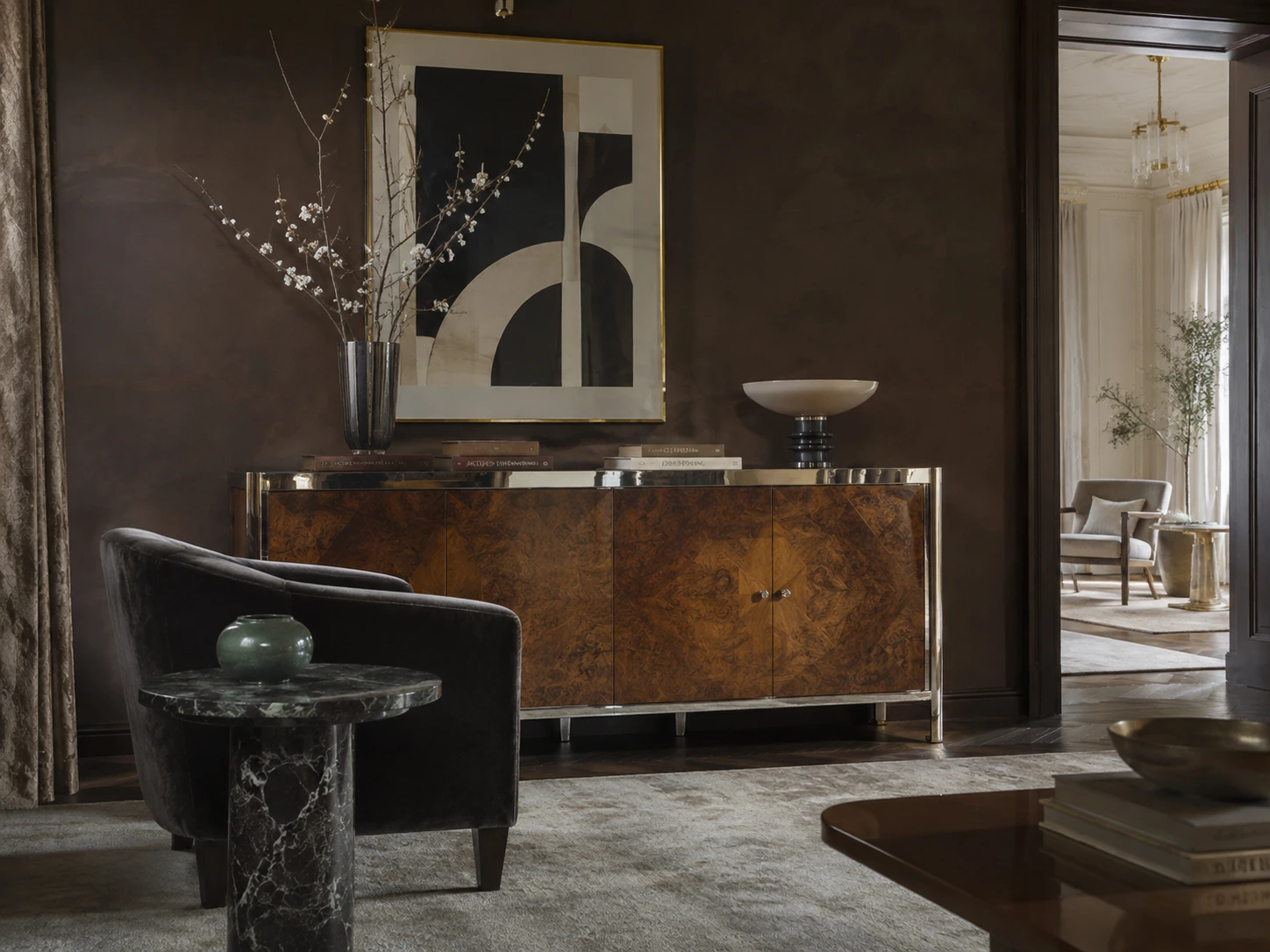
There's a reason 1920s interest doesn't feel out of step with 2026.
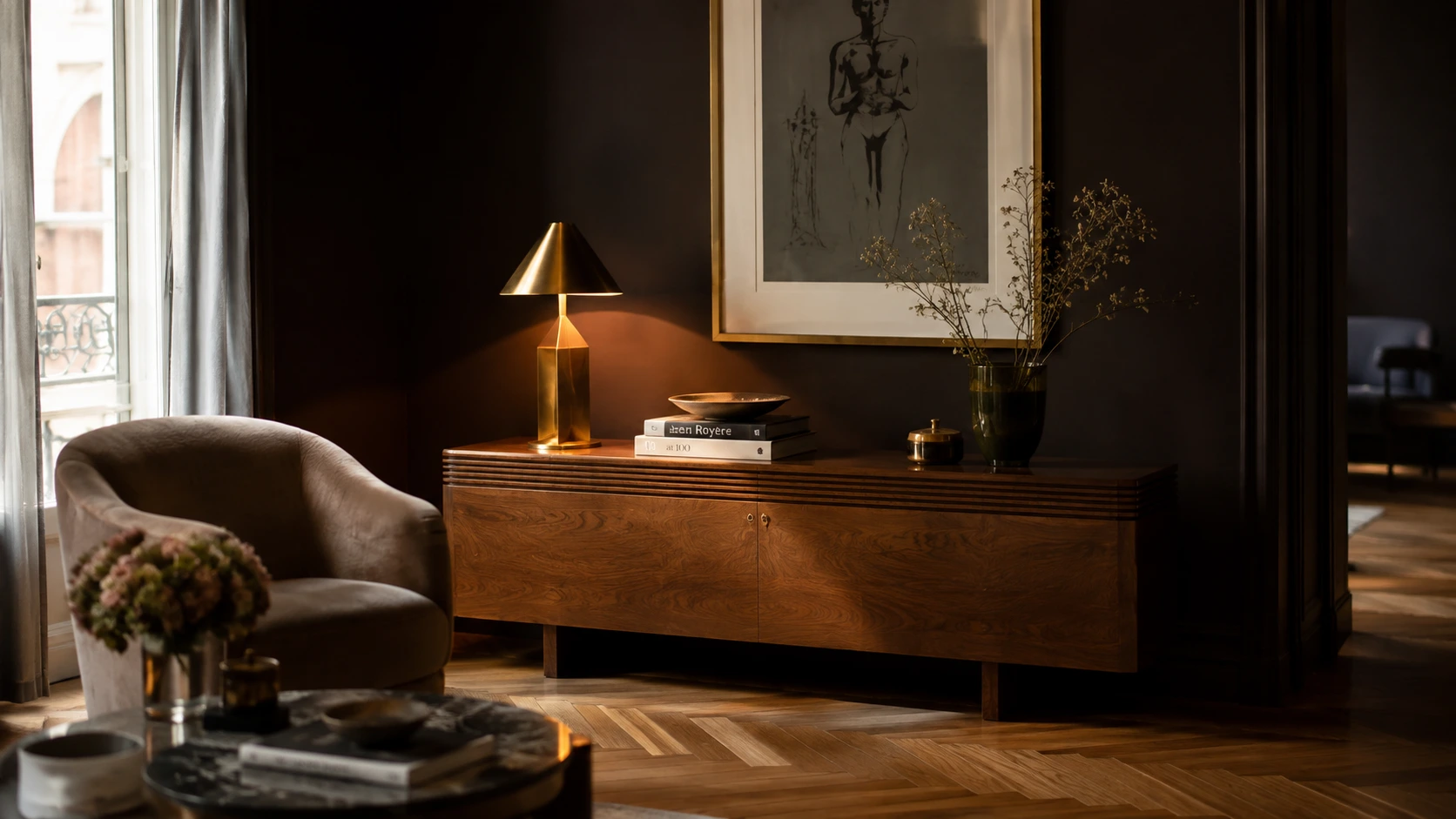
Benjamin Moore named Silhouette AF-655—an espresso brown—its 2026 Color of the Year, announced in October 2025. Its 2025 colour, Cinnamon Slate, was brown-family too. Two consecutive years of deep, warm, saturated neutrals from the largest name in American paint.
Deep browns, chrome, geometry, warm metals: the 1920s palette and the 2026 palette are not strangers.
I'd stop short of claiming one caused the other. But if you're wondering whether decade-referencing decor will look dated next year, the colour direction suggests otherwise.
If you work with keyword exports in this niche, check your accents.
This dataset lists "home decor" and "home décor" as separate keywords with identical volumes. "Home décor ideas" and "home decor ideas" each report 301,000—that's one query counted twice. Normalise the é and deduplicate, and total volume drops from about 3.3 million to about 2.74 million.
The raw file overstates by roughly 20%. Anyone summing this export without normalising is reporting a market a fifth bigger than it is.
In the 1960s. Historians coined the term retrospectively from the name of the 1925 Paris Exposition Internationale des Arts Décoratifs et Industriels Modernes. Nobody working in the 1920s called it Art Deco.
The style emerged in western Europe during the 1910s and 1920s and dominated the interwar years. It fell out of favour afterwards and wasn't widely celebrated again until the 1980s.
Clean geometric shapes, streamlined forms, and stylised ornament, in materials including chrome, silver, jade, ivory, rich woods, and early plastics.
Search interest in 1920s decor currently exceeds interest in current-year trend queries. The centenary and the shift towards rich, warm brown palettes make it feel remarkably contemporary.
Written by
Sarah BigelowSarah Bigelow is the lead designer and founder of Bigelow Designs. With over 15 years of experience in residential interiors, she tests every layout, material, and fixture in real homes before recommending them.
Keep reading
Warm minimalism interior design requires 55 to 75 LRV paints, 2700K lighting, and 0.80 NRC acoustics. Master tactile palettes and architectural reduction.
8 min read
A US export dated 18 June 2026 shows 9,930 home decor searches with seller intent against 1,525,350 consumer searches. Advertisers pay 4.4 times more for them.
8 min read
A modern house does not cost $162 per square foot to build. That figure is 2024 direct cost only. See the corrected math and the modern premium.
9 min read
The Insider Circle
Craving more interior inspiration? Watch our exclusive behind-the-scenes room tours on TikTok and join our Facebook community for daily design secrets.
Join the conversation
Thoughts, questions, or your own experience with this piece? Sign in with your Facebook profile to reply.

